After a devastating crash, a young father’s flick of movement rewrote his future
The rehabilitation team that guided his recovery now brings that same expertise to the new CoxHealth Rehabilitation Hospital
For weeks, Misty Hoy asked her son the same question.
“Steven,” she said softly, leaning close to the hospital bed set up in her living room. “Stick your tongue out.”
A neurologist had told her that would be the sign that Steven was coming back.
She asked him while she bathed him, while she cleaned his tracheostomy and while she stretched the muscles in his arms and legs.
Steven never did.
Her 20-year-old son, Steven James, of Noel, Missouri, had survived a catastrophic car accident, emergency surgeries and weeks in intensive care. But he had come home still unconscious — stable yet unable to speak, swallow or move on his own. Several doctors had told Misty and her husband, Jeremy, that if their son lived, he would likely remain in a vegetative state.
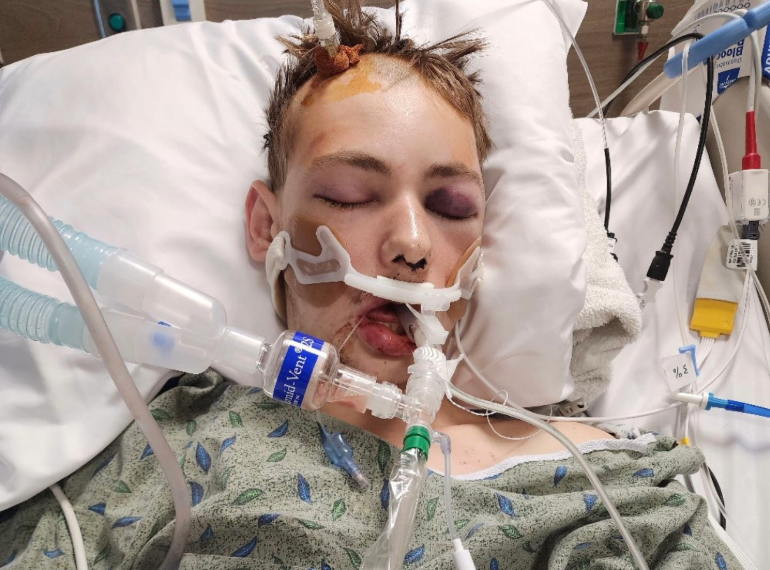
Then one night, while Misty brushed his teeth, Steven did as she asked. He stuck out his tongue.
“That’s when everything changed,” she said.
An injury no one expected him to survive
Before the crash, Steven was known for his energy. He was a jokester, Misty said – always full of life and always working hard.
After the accident, none of that seemed possible any longer.
Steven sustained a ruptured spleen, punctured lungs, multiple fractures and a severe traumatic brain injury. He was flown by medical helicopter to a trauma hospital in Arkansas, where surgeons worked to stop internal bleeding and inserted a probe into his skull to monitor swelling and pressure in his brain.
Early on, doctors warned the family just how serious the injury was.
“They told us normally the next 24 hours are critical,” Misty said. “But with Steven, it was hour to hour.”
At one point, neurologists described the severity of his brain injury as comparable to shaken baby syndrome.
“We were told again and again that he would never wake up,” Misty said.
Steven remained unconscious. When sedation was reduced, his heart rate spiked. When there was too much stimulation, pressure in his brain increased. Every day felt like a vigil.
Steven’s friends camped out in the hospital’s waiting room – sleeping on the floor, playing cards or watching movies.
Each time Misty walked through, she was struck by the sight.
“These are Steven’s people,” she said. “They were there for him, and they gave me strength.”
A place with no expectations
Nearly three weeks after the crash, Steven transferred to Select Specialty Hospital – Springfield. He arrived on a ventilator, with a tracheostomy, a feeding tube and multiple IV lines. One of his arms had already begun to draw up and weaken.
Misty walked in believing recovery was out of the question.
“I went in with no expectations,” she said. “I thought my son was going to be (in a vegetative state) for the rest of his life, and I was going to learn how to take care of him.”
The next day, she met Dr. Jesse Neeley, the hospital’s medical director.
He reviewed Steven’s chart — the surgeries, the scans, the weeks without response — and then he said something she had not heard before.
“I can’t promise you 100 percent of your son,” he told her. “But I can give you 80 percent.”
Even more stunning to Misty, he was confident Steven would wake up.
“He told us to be patient,” Misty recalled. “That was the first time anyone had given us hope.”
Laying the groundwork
At Select Specialty Hospital, Steven was treated like a person, not a patient without awareness.
“They talked to him,” Misty said. “They treated him with dignity.”
While Steven lay unconscious, Misty filled his room with large picture boards — photos of the life he had before the crash. Steven with his six siblings. Steven with his girlfriend and their toddler son. Steven laughing with friends. Everyone who entered the room saw them. Long before he could respond, everyone was introduced to the real Steven.
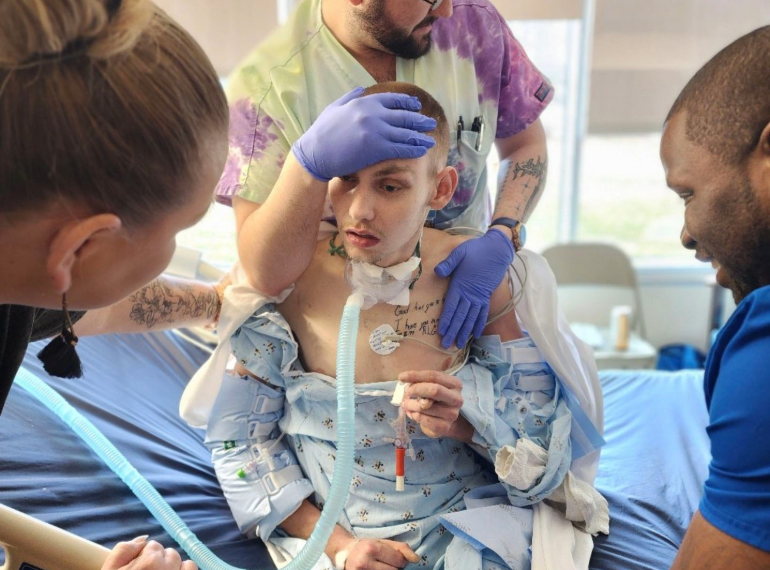
At first, Misty questioned why Steven’s care team stretched and moved his body several times a day.
Just let him be, she thought to herself.
Then nurses and therapists explained it was to preserve muscle memory and mobility and to prevent bed sores.
“They didn’t just keep him alive,” Misty said. “They laid the groundwork for him to come back to us.”
Medications were adjusted slowly and deliberately, with Dr. Neeley explaining that Steven’s care was like driving on ice. “Slow and steady. No abrupt turns,” Misty recalls.
Over time, Steven was able to breathe without the ventilator. Sedation was gradually withdrawn. Subtle signs began to appear — small movements, moments of agitation that suggested his brain was responding.
Still, after four weeks, their insurance company said it would no longer pay for Steven to be at the hospital. Steven discharged home.
Waiting at home
Misty turned their living room into a hospital room. Steven’s family and his girlfriend, Jasmine – the mother of their 18-month-old son, Clinton – learned everything: tracheostomy care, feeding tube management, turning schedules, basic therapy techniques.
“It was a family effort,” Misty said.
And every day, multiple times a day, they asked Steven the same question.
“Steven, stick your tongue out.”
And then one night, he did.
Proof he was waking up
In the days that followed, Steven began responding to other simple commands. He squeezed hands. Gave a thumbs up. Kissed Jasmine’s hand when asked.
Misty realized that when she brushed Steven’s teeth, he now sucked and swallowed the water from the brush. She immediately bought him stage one baby food – “bananas, because who doesn’t like bananas?” – and Steven ate it. Misty ordered a food processor from Walmart and the night she made manicotti for her family, she pureed some for Steven, too.
“He ate and ate,” Misty said.
The family also got Steven out of bed and on his feet, holding onto him so he wouldn’t fall.
Days later, Steven returned to Select Specialty Hospital - Springfield, this time to its inpatient medical rehabilitation unit, Select Medical Rehabilitation.
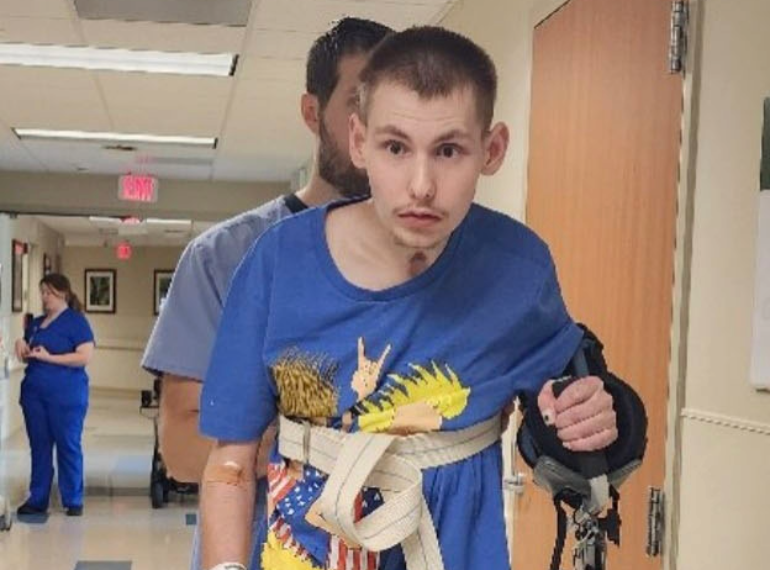
Steven arrived unable to walk, talk, eat, dress himself or move independently. He required a Hoyer lift for all transfers.
“What happened over the next month still amazes me,” Misty said.
Through daily physical, occupational and speech therapy, Steven began relearning skills he had lost. Within a few days, Steven stood and took steps in a gait-training machine that supported his body.
“The first time I saw him standing, I cried,” Misty said. “This was a child I was told would be in a vegetative state his whole life — and there he was, standing and taking steps.”
Steven’s leg muscles were so strong that the following day, he walked with a walker.
One of his arms had severely atrophied so Steven was fitted with a special brace that was adjusted every few days to advance his ability to extend his arm. When he began, his arm was curled at a 90-degree angle. A month later, he could completely open it. Mirror therapy also made a big difference, Misty said. Months in bed had altered his posture and when he was finally able to stand, he could only look down. By watching himself in a mirror every day, he was able to retrain his neck to look up.
With therapy bands, light weights and daily walking, Steven rebuilt core strength. Adaptive tools helped him relearn to brush his teeth, feed himself, dress and use a toilet – activities that brought a sense of accomplishment. “You could just see the joy in his face,” Misty said.
Meanwhile, back at his home, little Clinton was learning some of those same skills for the first time.
“Father and son,” Misty said, “at completely different ages but in the same season of life. That parallel still touches my heart.”
Steven’s feeding tube was removed, as was his tracheostomy, paving the way for him to speak again.
“The first time Steven said ‘Mama,’” Misty said, “that was the best sound I have ever heard.”
Despite the hospital being two hours from their home, Steven’s friends often visited. They listened to music, went out in the courtyard and even played cornhole together. Misty saw her son’s life slowly returning.
Four weeks after admission, Steven returned home walking with assistance and managing much of his care. His first meal at home was a cheeseburger and fries.
Where he is now
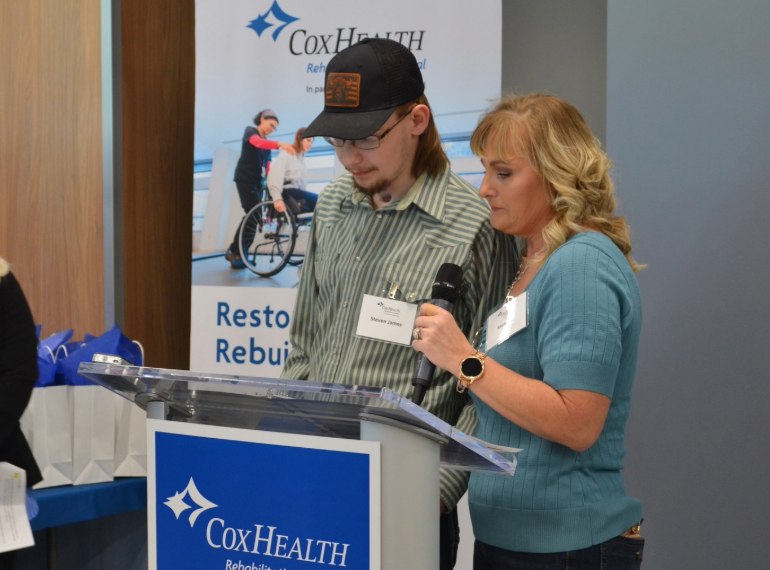
Today, Steven continues to recover. He walks mostly independently, using a cane when needed. He goes to the gym to work on strength, balance and mobility. He fixes his own plate, stacks wood around the house and plays with his son.
Recently, Misty noticed Steven’s personality returning. Although he had been awake for months, she hadn’t seen him smile or joke.
“Now he’s back to cutting it up with us,” she said.
She recently shared Steven’s story at a ribbon cutting for CoxHealth Rehabilitation Hospital – a new freestanding inpatient rehabilitation hospital in Ozark, Missouri, that replaces Select Medical Rehabilitation – Springfield. Dr. Neeley and his team now care for patients at the new hospital.
Standing beside Steven, Misty told the audience, “Don’t give up. Even in the darkest of days, there’s always hope.”